


Ask a legal AI system what "interest" a lender holds in a loan agreement, and you'll often get an answer that covers five different legal meanings at once: security interest, beneficial interest, interest rate, accrued interest, conflict of interest. It reads as comprehensive. It isn't. It's a system that never committed to an interpretation, dressed up as one that did.
Our new whitepaper, Governance-Aware Semantic Interpretation in Legal AI, measures exactly how much that matters, and puts a number on the reliability gap between legal AI systems that resolve ambiguity explicitly and ones that don't.
Words like interest, security, default, and party don't have one legal meaning. They have several, each tied to a different body of law and a different downstream consequence. A skilled attorney resolves this automatically, using context and training. A general-purpose language model often doesn't resolve it at all. It hedges, blending multiple readings into one fluent, plausible-sounding answer that a reviewer cannot actually audit, because no one can tell which question the system thought it was answering.
We call this interpretive hedging: the tendency of non-disambiguated systems to blend legally distinct senses to look complete while committing to nothing. Its evaluation-side counterpart, false completeness (or the "coverage illusion"), is the reason hedged answers often score well on conventional review: breadth reads as thoroughness, even when it quietly shifts the interpretive work back onto the human reviewer.
We built an evaluation framework, the Answer Evaluation Application (AEA), that scores legal AI answers across nine dimensions: semantic accuracy, sense commitment, audit trail quality, traceability, legal precision, and more. For each of 15 real legal questions against a securities loan agreement, we generated two answers: a raw answer with no disambiguation, and a disambiguated answer produced after the system explicitly resolved each ambiguous term against a curated legal ontology and tagged every claim to its source passage.
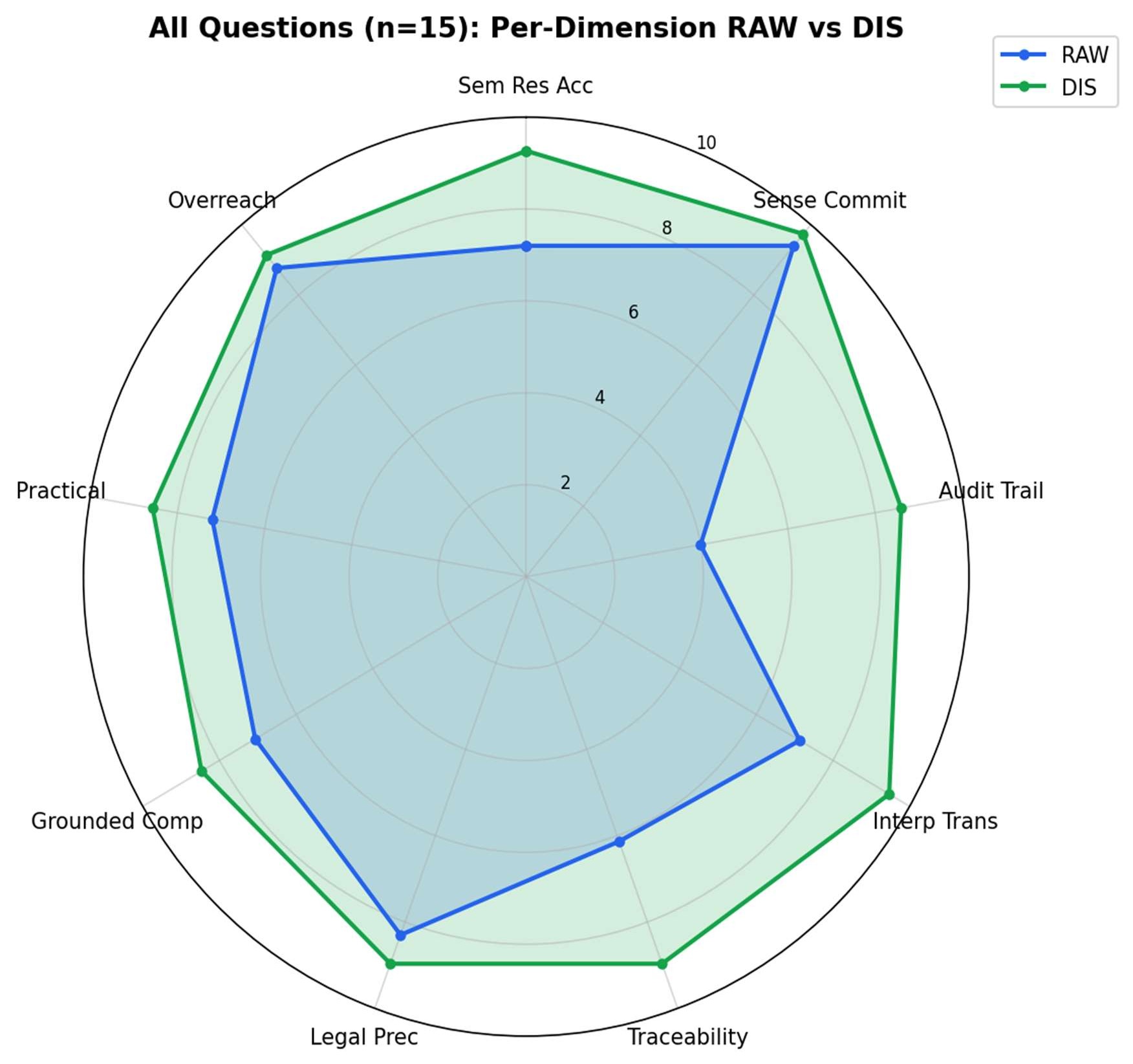
Disambiguated answers averaged 9.06 out of 10; raw answers averaged 7.16, a 27% lift in mean composite score. But the more useful finding is where that gap concentrates. On high-ambiguity questions, disambiguation widened the gap to roughly 4.1 points. On moderate- and low-ambiguity questions, where the intended meaning is close to explicit in context, the gap shrank to under one point.
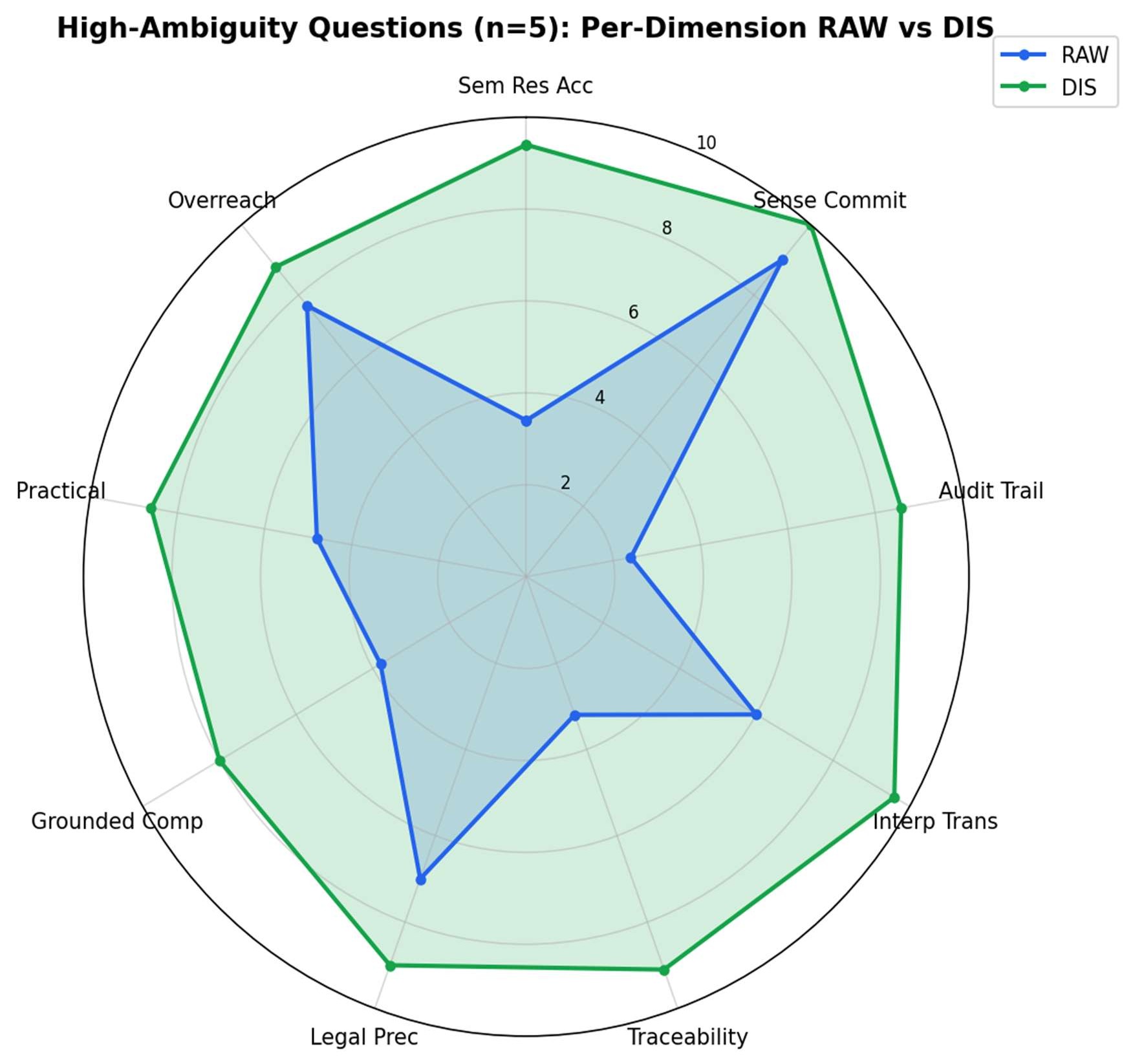
That pattern is the strongest evidence in the paper: the lift isn't a flat "better writing" effect. It shows up precisely where ambiguity is genuinely load-bearing, and disappears where it isn't.
The two largest contributors weren't legal writing quality: they were architectural. Disambiguation audit trail (+4.6 points) and traceability and provenance integrity (+2.8 points) accounted for most of the difference. Raw answers, by design, don't record which interpretation they chose or which source passage backs each claim. That's not something better prompting fixes; it requires a pipeline that treats interpretation as a recorded step rather than an invisible one. Legal precision and practical usefulness, by contrast, only improved modestly (0.7–1.4 points), since capable base models already write competent legal prose. The gap that matters is auditability, not fluency.
For legal teams evaluating AI vendors, the conventional question ("does this system produce good answers?") is necessary but not sufficient. The more useful question is: can I defend this answer if it's challenged? A system that can't show which interpretation it committed to, or trace a claim back to a source passage, creates exposure in exactly the workflows where it matters most: contract review, regulatory mapping, due diligence, and anything that might face later audit or litigation scrutiny.
The full whitepaper walks through the evaluation methodology, a worked example tracing one question end-to-end through the system's decision log, a control test against a simpler LLM-only disambiguation approach (and where it fails), and the operational risk categories this creates for enterprise legal deployment.
Expertise, applied.
Across your work.
© 2026 Primal Fusion Inc. · 210–137 Glasgow Street, Office 163, Kitchener, Ontario N2G 4X8, Canada